Expressive Arts Therapy: Healing Beyond Words
Expressive arts therapy offers a creative way to explore emotions, process difficult experiences, and build self-awareness through art, movement, writing, music, storytelling, and other forms of expression. No artistic experience is required.
Expressive Arts Therapy: Healing Beyond Words
By Dr. Kimberly Garrison
Expressive arts therapy offers a creative way to explore emotions, process difficult experiences, and discover more about yourself when words alone may not feel like enough. Through art, movement, writing, music, storytelling, and other forms of expression, therapy can create new pathways for understanding your internal experiences.
What if you could explore your emotions, process difficult experiences, and discover more about yourself without having to find the perfect words?
For many people, traditional talk therapy is an incredibly valuable tool for healing and personal growth.
But sometimes, words simply are not enough.
You might know that something is bothering you but struggle to explain exactly what you are feeling. Or perhaps you have talked about an experience countless times and still feel like there is something left to process.
That is where expressive arts therapy comes in.
Expressive arts therapy offers a creative, flexible approach to mental health treatment that allows individuals to explore their thoughts, emotions, and experiences through artistic expression.
And the best part?
You do not have to consider yourself creative or artistic to benefit.
What Is Expressive Arts Therapy?
Expressive arts therapy is an approach to counseling that incorporates creative expression into the therapeutic process.
While you may have heard of art therapy, music therapy, or drama therapy, expressive arts therapy can bring together multiple creative mediums to help clients explore their internal experiences.
This is sometimes described as an intermodal approach, meaning therapists and clients can move between different forms of creative expression depending on what feels most natural, meaningful, or helpful in the moment.
Rather than relying exclusively on conversation, expressive arts therapy creates opportunities to communicate and process experiences through visual art, movement, writing, music, storytelling, and other creative activities.
A session might include:
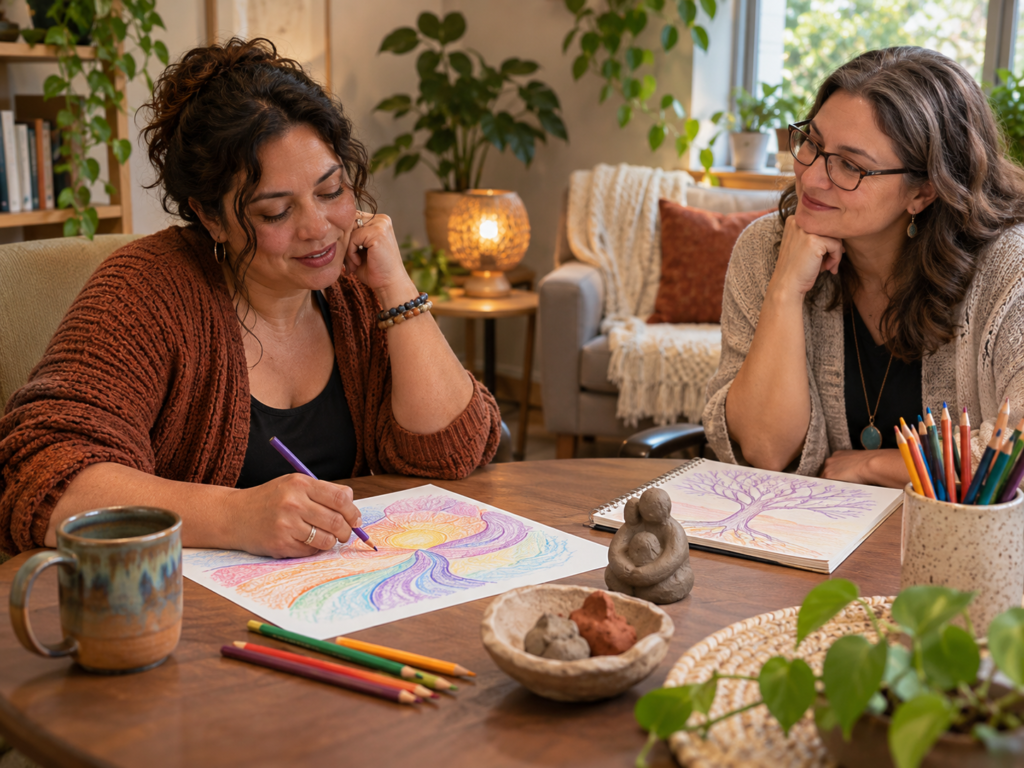
Collage and creative writing: Creating a collage using images and words, then transforming those ideas into a meaningful poem or reflection.
Movement and drama: Using movement or role-play to explore emotions, relationships, or experiences that are difficult to describe verbally.
Sculpture and storytelling: Creating a character from clay and developing a story that reflects personal challenges, strengths, or hopes.
Painting and poetry: Expressing an emotion through painting and then writing a poem inspired by the artwork.
Music and reflection: Exploring how different sounds, rhythms, or songs connect with emotions and personal experiences.
There is no single right way to participate.
The creative process can be tailored to each person’s comfort level, interests, and therapeutic goals.
How Does Expressive Arts Therapy Work?
Have you ever experienced an emotion so deeply that you could feel it in your body but could not quite put it into words?
Maybe you felt overwhelmed, anxious, disconnected, or sad without fully understanding why.
Or perhaps you knew exactly what happened but struggled to communicate how the experience affected you.
Expressive arts therapy offers another pathway for exploring those experiences.
Creative activities can engage emotional, sensory, and cognitive processes in ways that differ from verbal conversation.
Through artistic expression, clients may discover new perspectives, recognize patterns, or connect with feelings they have not yet been able to articulate.
For some people, creating something tangible can make an abstract emotion feel easier to understand.
For others, movement, music, writing, or storytelling may provide a sense of freedom that traditional conversation does not always offer.
Natalie Rogers, a pioneer in expressive arts therapy, emphasized creativity as a way to connect with deeper layers of emotion and self-awareness. Her person-centered approach focused on creating a supportive, nonjudgmental environment where people could freely explore their authentic experiences.
In expressive arts therapy, the goal is not to create something beautiful or impressive.
The goal is to become curious about what emerges during the creative process.
Sometimes that process leads to powerful insight.
Other times, it simply provides a meaningful opportunity to experience and express emotions differently.
Both can be valuable parts of healing.
What Can Expressive Arts Therapy Help With?
Expressive arts therapy can be incorporated into treatment for a variety of emotional and psychological concerns.
Depending on the individual and their treatment goals, expressive arts therapy may support people experiencing:
Anxiety and stress: Exploring overwhelming emotions and developing new ways to express and manage stress.
Depression: Creating opportunities for emotional expression, self-reflection, and reconnection with meaningful experiences.
Trauma and difficult life experiences: Providing alternative ways to explore experiences that may be challenging to discuss directly, at a pace that feels safe and manageable.
Grief and loss: Expressing complicated emotions associated with loss, change, and major life transitions.
Self-esteem and identity: Encouraging self-discovery, personal expression, and a deeper understanding of one’s authentic self.
Emotional regulation: Building awareness of emotions and experimenting with healthy ways to express them.
Relationship challenges: Exploring interpersonal patterns, communication, and emotional needs through creative reflection.
Expressive arts therapy is not necessarily a replacement for traditional talk therapy.
Instead, it can complement other therapeutic approaches and provide additional tools for clients who benefit from creative exploration.
Is Expressive Arts Therapy Really Therapy?
Absolutely.
Although expressive arts therapy may look different from what you imagine when you picture a traditional counseling session, it can still be part of psychotherapy when provided by a qualified mental health professional.
Expressive arts therapists use clinical knowledge, the therapeutic relationship, and intentional interventions to help clients work toward their mental health goals.
The difference often lies in the tools used during the process.
Instead of relying solely on verbal discussion, an expressive arts therapist may invite you to draw, write, move, create, tell a story, or experiment with different forms of expression.
These activities are not simply arts and crafts.
They are thoughtfully integrated into therapy to support emotional exploration, insight, self-awareness, and psychological well-being.
At Fearlessly Authentic Psychology, clinicians who incorporate expressive arts approaches use creativity as another way to help clients connect with themselves, process experiences, and work toward meaningful change.
What If I’m Not Artistic or Creative?
This is one of the most common concerns people have about expressive arts therapy.
The good news is simple:
You do not need artistic ability to participate.
You do not need to know how to paint, draw, dance, sing, write poetry, or play an instrument.
You do not even have to enjoy traditional art activities.
Expressive arts therapy is not about talent, technique, or creating something worthy of hanging on a wall.
It is about the experience of creating.
A drawing made of stick figures can be just as meaningful as an elaborate painting.
A few words scribbled on paper can offer just as much insight as a beautifully written poem.
There are no grades, critiques, or expectations to produce something impressive.
In fact, letting go of the pressure to do something “right” can become an important part of the therapeutic experience.
For people who struggle with perfectionism, self-criticism, or fear of judgment, expressive arts therapy may offer an opportunity to practice curiosity, flexibility, and self-acceptance.
Your therapist can work with you to identify activities that feel comfortable and appropriate.
You always have a voice in how you participate, and you should not be expected to engage in an activity that does not feel right for you.
Expressive Arts Therapy and Emotional Regulation
One reason creative expression can be valuable in therapy is that not every emotional experience begins with words.
Sometimes we first notice an emotion through tension in the body, an image that comes to mind, an urge to move, a memory, or a feeling that is difficult to explain.
Expressive arts therapy can create space to slow down and explore those experiences without immediately needing to define them.
Through creative exploration, clients may become more aware of what they are feeling, what situations trigger certain emotions, and how they typically respond.
That increased awareness can support emotional regulation and help people develop healthier ways to understand and express what they are experiencing.
Discovering New Ways to Connect With Yourself
Healing does not always happen through conversation.
Sometimes it happens when we allow ourselves to create without judgment, explore without expectations, and express what we have been carrying inside.
Expressive arts therapy invites us to approach our internal experiences with curiosity rather than criticism.
It creates space for emotions that may be difficult to name and offers new opportunities to connect with parts of ourselves we may have overlooked.
At Fearlessly Authentic Psychology, we believe meaningful healing can involve discovering and embracing your authentic self.
Expressive arts therapy is one of the many ways we can support clients on that journey.
You do not have to be an artist to experience the benefits of creativity.
You simply have to be willing to explore.
Expressive Arts Therapy in Denver and Lakewood
If you have difficulty putting emotions into words, feel stuck in traditional talk therapy, or simply want to explore a more creative approach to personal growth, expressive arts therapy may be worth considering.
Fearlessly Authentic Psychology offers therapy for clients in the Denver and Lakewood area, including clinicians who may incorporate expressive arts techniques alongside other therapeutic approaches based on each client’s needs and goals.
Learn more about our therapy services or contact Fearlessly Authentic Psychology to find out whether expressive arts therapy may be a good fit for you.